


Planning a company event for 30 people sounds straightforward until the quotations arrive. One venue includes tables but charges separately for a microphone. Another lists a tempting rental rate without the time needed to set up. A third seats 30 in rows, but not around tables for a working lunch. For a small business, those differences can decide whether the event feels effortless or expensive.
Quick answer: To plan a small corporate event in Mississauga, first decide what guests should accomplish, confirm a realistic headcount and format, compare venues by the actual seating layout, request itemized quotes, plan catering and AV, assign one event-day coordinator, and confirm every detail in writing. For an event with 10–40 guests, a four-week planning schedule is a useful starting framework; a more complex or high-demand booking may need longer.
This guide focuses on the kind of gathering a local HR manager, executive assistant, founder or office administrator might organize: a 30-employee appreciation afternoon, a client presentation, a small company town hall, a training session or a team workshop. You will find a worked budget example, a room comparison matrix, a sample run-of-show and a free three-page printable event-planning worksheet (PDF).
Free printable resource • PDF
Small Corporate Event Planning Checklist
Download a ready-to-use 3-page planner with a 30-person event brief, budget worksheet, venue quote questions, accessibility checks and day-of responsibilities. No email required.
Download Free Event Planner (PDF)
3 pages • Printable • Opens in a new tab
Editorial note: Financial examples below are deliberately hypothetical planning assumptions, not quotes from Mississauga venues. Availability, final capacity and services must be confirmed with the individual provider. Research checked October 30, 2026.
Start with a one-page event brief, not a venue search
Before looking at photos of meeting spaces or choosing a menu, write down the reason for the event. For a corporate gathering, “get everyone together” is often too broad to guide spending. Instead, decide which single outcome matters most: a decision, a completed workshop, a product demonstration, stronger client relationships, recognition for employees or an opportunity to meet local partners.
A practical event brief should contain the following:
- Outcome: What should attendees learn, decide, complete or feel by the end?
- Audience: Employees, managers, clients, partners or a mixture; confirm an expected number rather than automatically inviting the entire contact list.
- Format: Presentation, classroom-style learning, discussion, seated meal or networking reception.
- Schedule: Preferred date, backup date, guest arrival, main programme, food service and venue access times.
- Non-negotiables: Accessibility, privacy, travel time, audiovisual equipment, dietary accommodations and the total spending limit.
- Owner: One person authorized to approve changes and answer venue questions.
For example, a 30-person internal kickoff might have one concrete success measure: “Every department leaves with a named owner and two agreed priorities for the next quarter.” That sentence helps determine whether you need banquet seating and entertainment or a collaborative room with whiteboards and tables.
Which type of corporate event venue works for 10–40 guests?
A venue that advertises “up to 40 people” may only achieve that number in a theatre-style arrangement. Thirty attendees working on laptops need considerably more table space than 30 people listening to a short talk. Always ask for capacity in the exact planned configuration, including any buffet, registration table, camera tripod or extra furniture.
| Venue type | Most useful for | Critical question before booking |
|---|---|---|
| Private meeting room or boardroom | Leadership discussion, interviews, focused client sessions | Can everyone sit comfortably around the table, and is screen sharing included? |
| Flexible multipurpose event room | 20–40-person workshops, company updates, recognition events | Does the preferred layout leave room for catering, accessible circulation and equipment? |
| Restaurant private dining room | Client appreciation, team dinner, low-tech celebrations | Is the room fully private, and what are the food-and-beverage minimums? |
| Community or municipal rental room | Practical workshops, training and community-facing business sessions | Which furniture, insurance requirements, AV and staff support are included? |
| Hotel or convention facility | Formal programmes, multiple sessions, guests travelling from different areas | Are minimum spends and service charges proportionate to a small event? |
Mississauga’s municipal rental programme offers community rooms and other facilities suitable for workshops and gatherings. Its booking process and available spaces differ from private venues, so read the City’s facility-rental overview before treating a community room as a guaranteed low-cost option. For a closer look at private small-team spaces, see our comparison of nine meeting-room options in and around Mississauga.
For 30 employees, choose the layout before the room
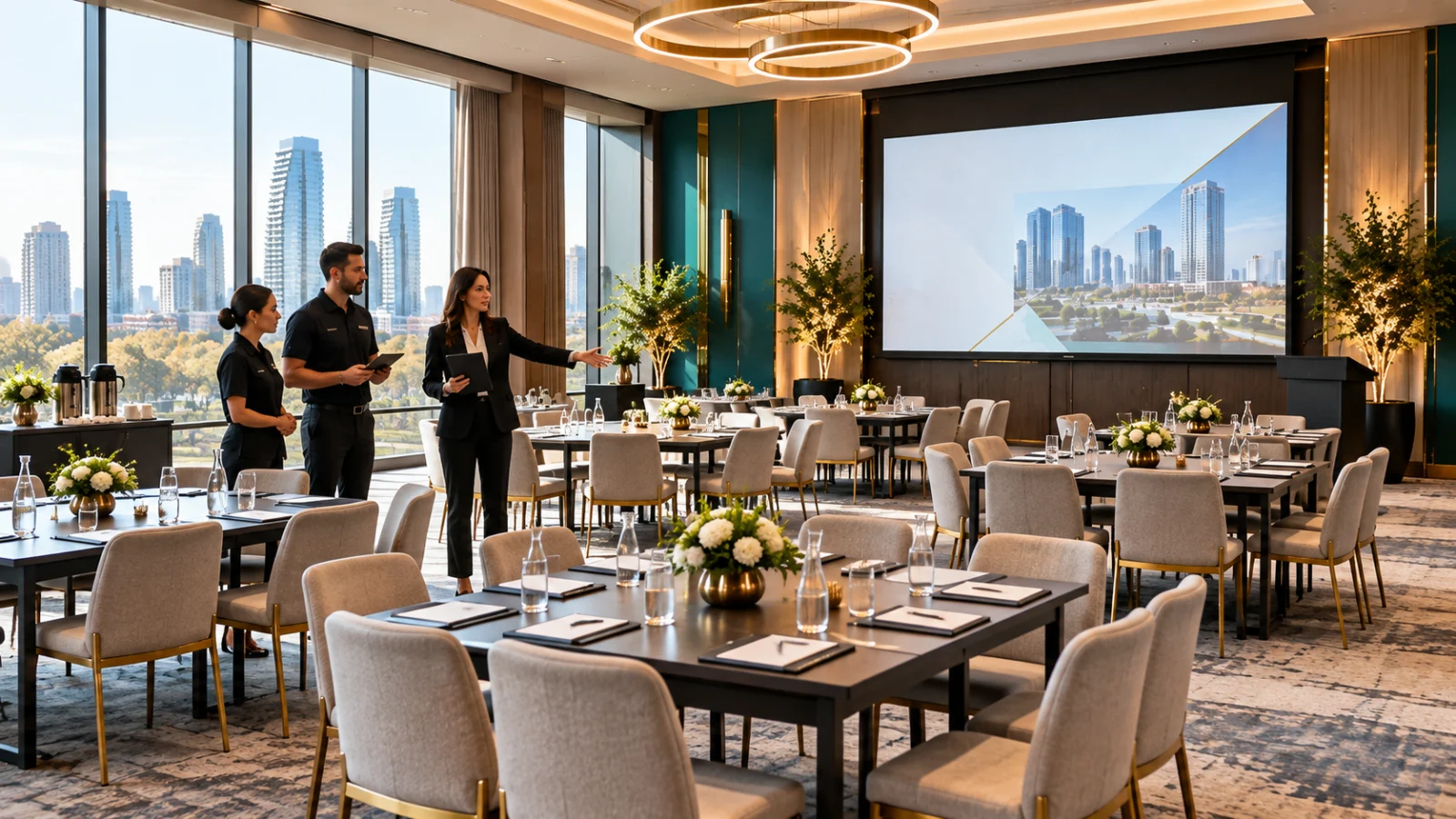
Consider a company kickoff with a 20-minute presentation and 50 minutes of group discussion. Theatre rows may be fine for the presentation, but people will have nowhere to open laptops or collaborate afterwards. Six tables of five people could make discussion easier, if the room allows that arrangement while preserving circulation. A single long boardroom table may work for a leadership discussion but feel awkward for 30 participants. Get an actual floor plan or layout photograph for the specific booking, rather than relying on the maximum capacity shown on the venue’s homepage.
How much should a 30-person corporate event cost in Mississauga?
There is no honest one-price answer. A short boardroom meeting with coffee is not equivalent to a four-hour team celebration with dinner, microphones and on-site support. The useful approach is to build an itemized working budget, ask multiple suitable venues for comparable quotes, then replace every assumption with a confirmed figure.
A transparent 30-guest budget example

Suppose you are planning a four-hour afternoon kickoff for 30 colleagues, with simple catering, one shared presentation screen and a modest amount of printed material. Here is a fictional budgeting scenario you can adjust. None of these amounts is advertised or verified pricing from Asyad or another Mississauga operator.
| Budget line | Example calculation | Amount (CAD) |
|---|---|---|
| Venue and basic furniture | Illustrative fixed allowance | $600.00 |
| Food and refreshments | 30 guests × $32 assumption | $960.00 |
| AV and technical help | Illustrative allowance | $180.00 |
| Signage and materials | Illustrative allowance | $90.00 |
| Other event support | Illustrative allowance | $120.00 |
| Subtotal | Sum of the five lines | $1,950.00 |
| Example HST | 13% of subtotal, assuming all lines are taxable | $253.50 |
| Contingency reserve | 10% of subtotal, held aside | $195.00 |
| Planning total | Subtotal + illustrative HST + reserve | $2,398.50 |
| Equivalent per attendee | Planning total ÷ 30 | $79.95 |
Ontario’s general harmonized sales tax is 13% on applicable taxable supplies, according to the Government of Ontario. Actual event proposals may treat different charges differently. Ask suppliers to identify tax, gratuities, service fees, overtime and minimum spends on their written quotation. Do not charge 13% twice if a supplier’s price already includes HST.
The useful comparison is the all-in cost, not the lowest hourly venue rate. A space charging less per hour can become more expensive once you add chairs, setup time, Wi-Fi or an AV technician. Our separate Mississauga meeting-room rental cost guide explains the common extras that can affect quotations.
Three budget mistakes to avoid
- Counting only programme hours. A three-hour programme may need extra venue time for setup, sound checks, guest arrival and cleanup.
- Comparing different packages. Quote A might include water, service staff and a microphone; Quote B might not. Move every inclusion into the same spreadsheet before deciding.
- Forgetting the reserve. Holding a small contingency allowance is useful for changes, but it is not a vendor quote or money you must spend.
A four-week corporate event planning timeline
Four weeks is a workable example for a straightforward small gathering with a flexible date and limited production needs. For a peak-season date, a larger supplier team or complex presentations, start earlier. Treat this as a sequence of decisions rather than a promise that every venue can be booked in four weeks.
| When | What to complete | Who owns it? |
|---|---|---|
| 4+ weeks before | Agree purpose, budget ceiling, guest count, date options and event owner; request venue quotes. | Event lead / budget approver |
| 3 weeks before | Choose the room and layout; confirm written terms, access, catering approach and essential AV. | Event lead / venue contact |
| 2 weeks before | Send invitations and arrival instructions; collect dietary and accessibility requirements; confirm speakers. | Communications / guest lead |
| 1 week before | Finalize headcount, run-of-show, room map, printable materials, supplier contacts and a backup plan. | All owners |
| 72–24 hours before | Reconfirm venue access, timing, catering quantities, weather considerations and technical rehearsal. | Event lead / AV lead |
| Event day | Arrive before guests, test AV, check the accessible route, brief staff, keep the agenda on time. | On-site coordinator |
| Next business day | Thank participants, share decisions, close invoices and document lessons for the next event. | Follow-up owner |
Sample run-of-show for a 30-person company kickoff
One of the easiest improvements to any event is a written run-of-show. It identifies not only what happens, but who makes each handoff happen. Here is an illustrative agenda for a programme starting at 2:00 p.m., with venue access arranged ahead of guest arrival.
| Time | Activity | Owner / checkpoint |
|---|---|---|
| 12:45–1:15 p.m. | Room setup, signage and AV test | Venue + AV lead |
| 1:15–2:00 p.m. | Guest arrival and refreshments | Registration lead |
| 2:00–2:20 p.m. | Welcome and company update | Host |
| 2:20–3:10 p.m. | Small-group planning exercise | Facilitator |
| 3:10–3:25 p.m. | Break and refreshments | Catering lead |
| 3:25–4:00 p.m. | Team findings and decisions | Group representatives |
| 4:00–4:20 p.m. | Action owners, deadlines and closing | Host + note-taker |
| 4:20 p.m. onward | Optional informal conversation, then teardown | Venue + event lead |
Plan catering around the event, not the other way around
For a 30-person corporate event, catering choices should reflect why guests are there. A short afternoon strategy session may need water, coffee and easy-to-eat snacks. A longer workshop needs a substantial break and enough time to eat. A client appreciation gathering may call for more attentive service. Ask whether the supplier will provide serving tables, utensils, beverage stations, staff, cleanup and clearly labelled food.
Collect dietary requests in advance, but do not ask attendees to reveal unnecessary medical information. Confirm how the caterer handles declared allergens and whether there is a reliable contact for last-minute questions. If guests will serve themselves, ensure food and utensils can be reached by people using mobility aids; the Ontario accessible-event planning guidance hosted by the City of Mississauga includes practical considerations for buffet access, seating and clear circulation.
Make the meal fit the schedule: food service in the middle of a presentation is disruptive, while a long break after the final agenda item may cause people to leave before discussions conclude. Ask the caterer for a precise arrival and service time, not just “lunch included.” For local options, explore Asyad’s catering information and compare other suitable providers with verified quotes.
AV, accessibility and guest arrival: the details people remember

A room can look excellent in photos while creating problems for a person attending for the first time. Before booking, ask the venue to show you the guest journey from parking or transit drop-off to the actual meeting room. Check the building entrance, lift or stair requirements, accessible washrooms, signage and any change of floor. Tell attendees exactly where to go rather than sending only a street address.
Ontario’s Integrated Accessibility Standards regulation establishes accessibility standards for several areas of public life. Legal requirements depend on the organization and service; for an individual event, the practical starting point is to identify barriers and provide accommodations rather than assuming a venue is suitable because it has a general accessibility label.
A practical technical rehearsal
- Test the laptop and screen connection with the actual presentation file, including embedded video.
- Check whether speakers can be heard from the back and whether microphone or sound equipment is included.
- If remote guests are joining, test camera framing, microphone pickup, captions where appropriate, the conferencing platform and a backup connection.
- Check Wi-Fi access for attendees and whether essential devices require separate credentials or wired internet.
- Secure cables, provide accessible space around tables and ensure screens are readable from the chosen seating layout.
- Keep an offline copy of slides and one person who can resolve technical problems while the host continues the programme.
For an important event, never assume “AV available” means an operator, microphone, camera and screen are all part of the same price. Ask for the exact included equipment and the amount of setup or rehearsal time offered.
Does a small corporate event in Mississauga need a permit?
An ordinary private meeting in an established indoor venue is different from a public festival, market or outdoor event. Do not assume the same municipal application applies to every gathering. The City of Mississauga has a special event licence process for certain activities involving vendors and public-facing events, and separate procedures for municipal facility rentals and outdoor events.
If your plan involves outside vendors selling goods, a public-facing programme, alcohol service, temporary structures or use of public property, ask the venue and the City which rules apply well before advertising the event. A venue’s normal rental agreement is not automatically a substitute for permits, insurance or food-service compliance. This article is practical planning information, not legal advice or a determination of permit requirements for your specific event.
Compare venue quotes with one consistent scorecard
When you receive two or three proposals, do not immediately choose the cheapest. Build a side-by-side sheet with the same fields: date, precise room, capacity in the preferred layout, included furniture, screen and sound, time on site, staff support, food and beverage, cancellation terms, deposit, accessibility details, tax and the full payable amount.
One simple approach is to mark every requirement as confirmed in writing, requires clarification or not included. This prevents a memorable room photo or a promotional price from outweighing a missing essential. If your guest list includes people travelling from both Toronto and Oakville, compare their journeys rather than assuming every Mississauga address is equally convenient.
Copy this venue enquiry template
Hello, we are organizing a corporate gathering for approximately 30 guests in Mississauga. Our preferred date is [date], with a backup of [date]. The programme will run from [start] to [end], and we also need time for setup and teardown. We expect [presentation/workshop/networking] and would like [layout] seating, [AV needs], [catering plan] and an accessible guest arrival route. Could you confirm the exact room, seating capacity in this layout, all included services, available access hours, taxes, deposits, cancellation terms and total quotation? Thank you.
This specific enquiry creates much more useful proposals than asking, “How much does your venue cost for 30 people?” It tells the operator how the event will actually use the space.
Where Asyad Business Hub fits into a small corporate event
For teams exploring private options in West Mississauga, Asyad Business Hub lists meeting rooms, boardroom options and larger event spaces at Ridgeway Plaza, 3545 Odyssey Drive. Its advertised Nexus multipurpose space has a listed maximum of up to 40 guests, which may make it worth considering for a 30-person corporate workshop, kickoff or reception. However, the exact comfortable capacity depends on layout, furniture, food service and equipment, so the operator should confirm suitability for your particular event.
Disclosure: Asyad Journal is published by Asyad Business Hub. This article is an editorial planning guide, not an independent venue review. The budget example is not Asyad pricing and does not establish live availability. You can compare Asyad’s listed spaces or contact the venue team for a current quote. Readers should compare other operators using the same questions.
Download the small corporate event planning checklist
The useful output from this guide is not simply a better understanding of meetings. It is a finished brief your team can act on. Our three-page printable corporate event planner (PDF) includes an event brief, venue and accessibility checks, a fill-in budget worksheet, quote comparison, enquiry message and event-day ownership checklist. It is designed to print or save without signing up or sharing an email address.
Before booking, complete at least the date, headcount, preferred layout, essential AV, dietary requirements, accessible arrival route and all-in cost. If any of those remain blank, you are not yet comparing complete proposals.
Frequently asked questions about small corporate event planning in Mississauga
How do I organize a corporate event for 30 employees in Mississauga?
Set one clear goal, confirm 30 as the expected guest count, choose the right room layout, request two or three itemized venue quotations, agree a written budget, plan catering and AV, assign an event coordinator and create a timed run-of-show. Send directions and accommodation information before the event; reconfirm suppliers and technology near the date.
What is a reasonable budget for a 30-person company event?
It depends on the duration, room, catering style and production requirements. The worked $2,398.50 total in this article is an illustrative scenario, not an observed Mississauga average or a venue quote. Replace the example inputs with live quotations and confirm taxes and service charges.
How early should I book a corporate event space?
Start seeking quotes once the date, format and approximate count are known. Four weeks may suit a simple event with flexible options, but busy dates, multiple suppliers, special accessibility requirements or complex AV need more preparation. Do not assume a venue is available until the operator confirms the reservation.
Does a venue listed for 40 people always fit a 30-person workshop?
No. A 40-person maximum may refer to rows of seats. Tables, breakout groups, a buffet, AV equipment and clear circulation take additional space. Request the capacity for your actual floor plan and confirm accessibility and emergency exits.
How do I compare corporate event venues fairly?
Use the same brief for each provider. Compare total cost with tax and extras, exact room and layout, included equipment, access hours, catering, transportation, accessibility and cancellation terms. Mark missing answers rather than guessing them.
Do I need a planner for a 20–40-person event?
Not necessarily. A straightforward internal workshop can often be coordinated by an organized staff member with a clear budget, written supplier responsibilities and an event-day schedule. More complex production, entertainment or multi-vendor events may justify outside help.
What should happen after the event?
Within one or two business days, thank attendees, share agreed action items and owners, settle or review invoices and record what should change next time. If the purpose was a workshop, the quality of the follow-through matters more than a long photo gallery.
How can I compare event venues in Mississauga for a hybrid meeting?
Compare each venue against the actual remote and in-room experience: stable internet, microphone pickup, camera sightlines, speaker placement, screen visibility, power access, seating layout and an on-site technology contact. Ask for an equipment list, confirm whether a test call is possible, and compare the all-in quote including setup time and any AV charges. A venue should not be assumed to support hybrid meetings just because it advertises Wi-Fi or a projector.
Sources, assumptions and editorial method
This guide was researched using the City of Mississauga’s municipal facility rental information, the City’s special-event licensing page, Ontario’s HST guidance, the Integrated Accessibility Standards, and official Asyad Business Hub venue descriptions. The example budget, sample itinerary, comparison matrix and printable worksheet were developed for this article; they are not records of a real client event or claims of field-tested results.
Creation disclosure: This practical editorial guide was prepared with AI assistance using public sources and original planning examples. It does not claim first-hand venue visits, event attendance, live reservation checks or professional certification. Verify venue availability, legal requirements and final quotations with the relevant operators before making commitments. Published October 30, 2026.



4 comments