


Starting a business in Mississauga involves more than choosing a name and opening a website. You may need Ontario registration, a City business licence, zoning approval for the address and Canada Revenue Agency program accounts. The sequence matters: signing a lease before checking the permitted use of a property can become an expensive mistake.
Reviewed November 5, 2026. This practical guide brings together Ontario, City of Mississauga and CRA requirements for people researching how to start a business in Mississauga in late 2026 or 2027. It is an editorial checklist, not legal, tax or licensing advice. Check the linked official sources for current rules, application forms and fees before acting.
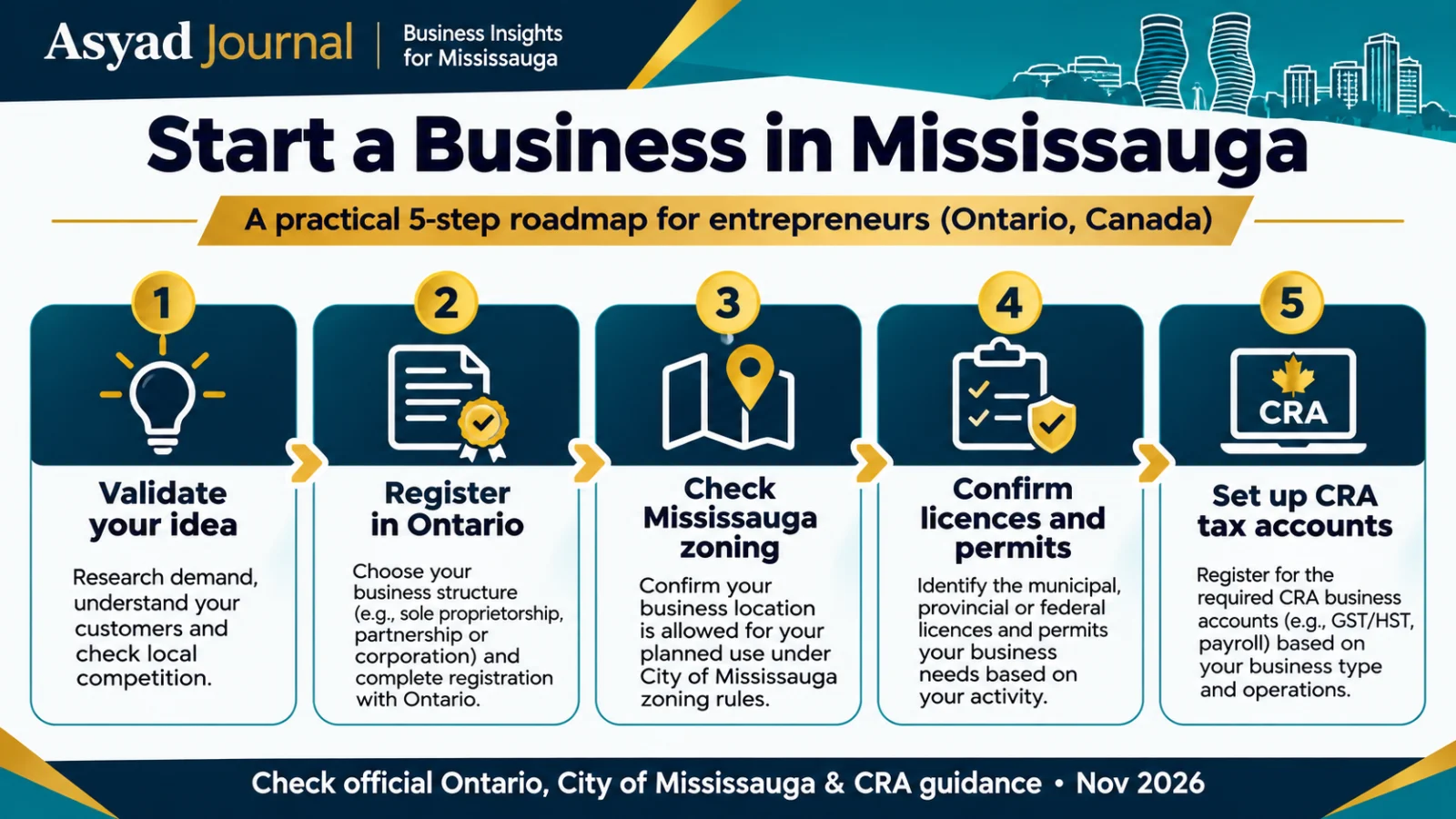
Starting a business in Mississauga: the short checklist
- Describe the product or service, customer, likely location and expected first-year expenses.
- Check competitors and test whether actual customers will pay, rather than assuming a registration makes the business viable.
- Choose an ownership structure with appropriate legal or tax advice.
- Confirm whether and how to register with the Ontario Business Registry.
- Before leasing or renovating, verify the proposed use against Mississauga zoning rules.
- Check whether your particular activity needs a municipal business licence or permit.
- Determine which CRA business number and tax accounts you need.
- Build a basic operating budget, recordkeeping process and customer-acquisition plan before launch.
Not every company has identical requirements. For example, a home office and a restaurant have materially different zoning, licensing, equipment and health considerations.
Step 1: Validate the business idea before paying registration fees
A business plan does not need to be fifty pages. Begin with five questions: who specifically will buy, what problem is solved, what alternatives customers already have, how the offer will be delivered and how it will make a profit after ordinary expenses. Compare at least three relevant local or online competitors. Note what they charge publicly, how clients contact them and what complaints appear repeatedly in legitimate feedback. Do not fabricate customer interviews or claim unverified prices.
For an initial market test, ask potential customers about real buying situations rather than whether they like an idea in theory. If you plan to operate in Mississauga, estimate the travel time, local customer density, lease or remote-operation costs and any access requirements. IDEA Mississauga has an official 10-step startup resource that can help structure the research.
Step 2: Choose a business structure and register in Ontario
The Ontario Business Registry supports a range of structures, including sole proprietorships, partnerships and corporations. There are differences in legal identity, liability, taxes and filing requirements; do not select one solely because its government registration fee is lower. Your exact obligation to register depends on how the business is organized and operates. Refer to the province’s registration guidance or seek professional advice if you have partners, investors, employees or unusual ownership arrangements.
| Ontario registration route | Published provincial filing fee | What to remember |
|---|---|---|
| Sole proprietorship business-name registration | C$60 | Check whether registration is required for your particular name and situation. |
| General partnership firm-name registration | C$60 | Partners should agree how responsibilities, profits and decisions are handled. |
| Ontario business corporation incorporation | C$300 | A named corporation may require an additional Ontario-focused Nuans name search report, purchased separately. |
The Ontario government explains that the Ontario Business Identification Number (BIN) and the federal CRA business number (BN) are different identifiers. Mixing them up can delay later paperwork. Keep copies of your registration confirmation and any corporation records rather than relying only on an email receipt.
Step 3: Check Mississauga business licences and permits
A provincial business registration is not the same as permission to carry out every kind of activity at every location. The City’s licence and permit directory lists local categories, application routes and current rules. Categories include restaurant and food retail businesses, personal services settings, certain trades, refreshment vehicles and other regulated activities.
The correct licence depends on what your business actually does. An online service provider, a food business, a plumbing contractor and a storefront may need different approvals. The City also directs entrepreneurs to BizPaL for researching possible permits and licences. Before paying, determine whether your specific activity is licensed by the City and whether other provincial or federal rules apply.
Licensing amounts also differ by activity. Do not budget a single generic “Mississauga business licence fee” without identifying the licence category. The City publishes fee schedules and requirements on its official pages. Some applications can be submitted online, while others require a different process; check the current licensing service page rather than following an old address or instruction found in a third-party post.
Step 4: Verify zoning before choosing a location
A retail unit, warehouse, private office, home workspace and restaurant are not interchangeable simply because the rent fits the budget. The City divides land into zones, each with permitted and restricted uses. You should review permitted uses for a non-residential property and ask City staff about the proposed business before signing an unconditional lease.
Mississauga’s Zoning Certificate of Occupancy system covers new uses or changes of use. The City’s current guidance lists a total application fee of C$515 for that certificate, with a C$50 non-refundable administration amount credited toward the total. That figure applies to the described certificate process, not to every business automatically. A zoning certificate does not replace building permits or other necessary approvals.
Before committing to a space, ask: Is the intended use permitted? Is an occupancy certificate needed? Are parking, public access, fire or renovation approvals relevant? Does the landlord authorize the intended use? Write these answers down and keep the City’s responses with your lease documents.
Step 5: Can you run a business from home in Mississauga?
Possibly, but the rules are specific. The City’s home-business zoning page identifies examples such as certain office uses, tutoring and music instruction, subject to dwelling type and by-law restrictions. It also says applicable home occupations and offices must obtain a Zoning Certificate of Occupancy.
The same City page specifically warns that home-based food preparation, cooking or catering businesses are not permitted under its zoning by-law. Do not assume that a home address used for mail, a permitted home office and a customer-facing commercial operation are all treated alike. Check the property’s zoning, tenancy or condominium conditions where relevant and ask City staff if the use is uncertain.
Step 6: Work out CRA business-number, GST/HST and payroll requirements
The Canada Revenue Agency explains when a business needs a BN and specific program accounts, including GST/HST and payroll. Not every unincorporated business automatically requires the same registrations. Incorporation or opening a particular tax account may change what is needed.
For many taxable supplies, the ordinary GST/HST small-supplier threshold is generally C$30,000 in the relevant period, but there are exceptions, special categories and rules about when to register and start collecting. Use the CRA’s current GST/HST decision guide rather than assuming every business below or above one amount is treated identically.
A current operational detail matters: CRA says access to Business Registration Online began requiring sign-in through a CRA account on July 14, 2026. If you are following an older tutorial showing a public registration flow, verify the updated CRA registration instructions first.
Step 7: Build a realistic first-month startup budget
Government registration is only one line item. Your total will depend on the business and may include a market test, supplies, equipment, insurance, software, accounting, signage, a permitted location, licence fees, deposits and professional help. Build three columns: expenses required before opening, expenses that recur each month, and items you can defer until demand is proven.
| Expense | How to estimate | Common oversight |
|---|---|---|
| Business registration | Choose the correct Ontario filing route and check fees | Assuming incorporation and a simple business-name registration cost the same |
| Municipal approvals | Check zoning, permit and licence categories for the actual activity | Signing a lease without confirming whether the use is permitted |
| Workspace | Compare at-home, shared and dedicated space with actual service needs | Ignoring deposits, utilities, guest access and additional fees |
| Operations | Budget equipment, insurance, recordkeeping and relevant technology | Counting only the purchase price and not recurring maintenance |
| Customer acquisition | Plan credible local discovery, outreach and website information | Expecting registrations or social accounts alone to generate customers |
Try a conservative scenario in which sales take longer than planned. A startup cost figure without any cash buffer is not an operating plan. Where finance is needed, compare the obligations carefully rather than treating loan eligibility as proof that borrowing is the best move.
Step 8: Look for local support and funding that matches your stage
The Mississauga Business Entrepreneur Centre offers guidance, workshops and mentorship for people starting or growing companies. IDEA Mississauga also publishes entrepreneur programs and events.
For an updated overview of grants, non-cash supports and financing, read our Mississauga small-business grants and funding guide for 2026–27. It distinguishes early-stage Starter Company Plus opportunities from IDEA Step-Up for more established innovative ventures, and separates grants from repayable loans.
Making business connections is another early investment. If you are seeking a local entrepreneurship community, the Asyad Journal networking events guide includes official event sources and notes which opportunities may suit founders at different stages.
Three example startups: how the steps change
Example A: a home-based consulting service
The owner should clarify their registration and tax setup, but also check the exact property and home-office zoning rules. A home office is not necessarily equivalent to an open-to-the-public commercial office. They may need minimal physical equipment, but still need an honest budget for software, privacy, records and finding customers.
Example B: a café or food retail business
The location and permitted use become especially important. Review the City’s restaurant and food retail licensing rules, applicable health requirements, building or occupancy matters and the true cost of food equipment before committing to the premises. A registered business name alone is not permission to open a café.
Example C: a software or technology startup
The founder should consider incorporation questions, intellectual property, privacy, financial records and whether the business can operate remotely or needs premises. If there is a viable business model and the founder meets program criteria, local mentorship or an appropriate innovation program could be useful. Funding eligibility is not a substitute for customer demand.
Frequently asked questions about starting a Mississauga business
How much does it cost to register a business in Ontario in 2026?
The Ontario government lists C$60 for a sole proprietorship business-name registration and C$300 for Ontario business corporation incorporation. Other structures and services differ. These figures do not include Mississauga licences, zoning, name-search costs or professional assistance.
Do I need a Mississauga business licence for every business?
Requirements depend on your activity and location. Use the City’s official licence and permit directory to determine whether your business belongs to a licensed category, and confirm with City staff if uncertain. Provincial business registration and municipal activity approval are separate questions.
Do I need zoning approval for a home business?
The City says applicable home offices and occupations must obtain a Zoning Certificate of Occupancy and follow property-specific rules. Check the current zoning page before operating.
Can I run a home-based food or catering business?
The City’s home-business guidance says home-based food preparation, cooking or catering is not permitted under its zoning by-law. If the business involves food, ask about compliant commercial locations and required licences instead of assuming a home kitchen will be approved.
Is an Ontario BIN the same as a CRA BN?
No. The province distinguishes its business identification number from the federal CRA business number used for federal tax program accounts. Keep both identifiers organized if your business receives them.
Is a C$30,000 revenue threshold the only GST/HST registration rule?
No. The general small-supplier threshold has specific calculation rules and exceptions. Consult the CRA’s current registration guidance or a qualified tax professional for your business activities.
Official source list and editorial method
Reviewed November 5, 2026. Primary references: Ontario’s start-a-business guide, Ontario registration and published fees, City of Mississauga business licences, City zoning certificate rules and fees, City home-business guidance, CRA business numbers, CRA GST/HST registration rules and IDEA Mississauga startup resources.
This is independent editorial content from Asyad Journal, part of Asyad Business Hub. Research and drafting used AI assistance with official-source verification. No claim is made that our team has inspected a reader’s premises, applied for licences on anyone’s behalf, or provided individualized legal, accounting or tax advice. Rules, fees and application processes may change; check the relevant authorities before taking action.




One comment
Comments are closed.